



Photo by Richard Hurd
Metro Metrics April 2026

Metro Metrics April 2026

Metro Metrics is a monthly data snapshot that explores key economic indicators reflecting the health of the Madison metro economy.
Workforce Geography
This month, the Chamber unveiled its new 2026-2028 Advocacy Agenda, "Ready/Set." The framing for the agenda details how increasing population growth projections and emerging technologies have set in motion profound changes in how we work, connect and live. This month’s Metro Metrics explores a key pillar of the agenda – elevated connectivity – and how our workforce location patterns are evolving.
Regional Employment Patterns
The U.S. Census Bureau publishes a data set called LODES (LEHD Origin-Destination Employment Statistics), which links where people live and work down to the census block level. By understanding home and workplace locations, we can assess growth and potential commuting patterns.
The most recent LODES dataset contains information from 2023. One limitation of the data to keep in mind is that it only tracks work patterns within a state. Any worker who lives in Wisconsin but works in another state, or vice versa, will not appear in the data.
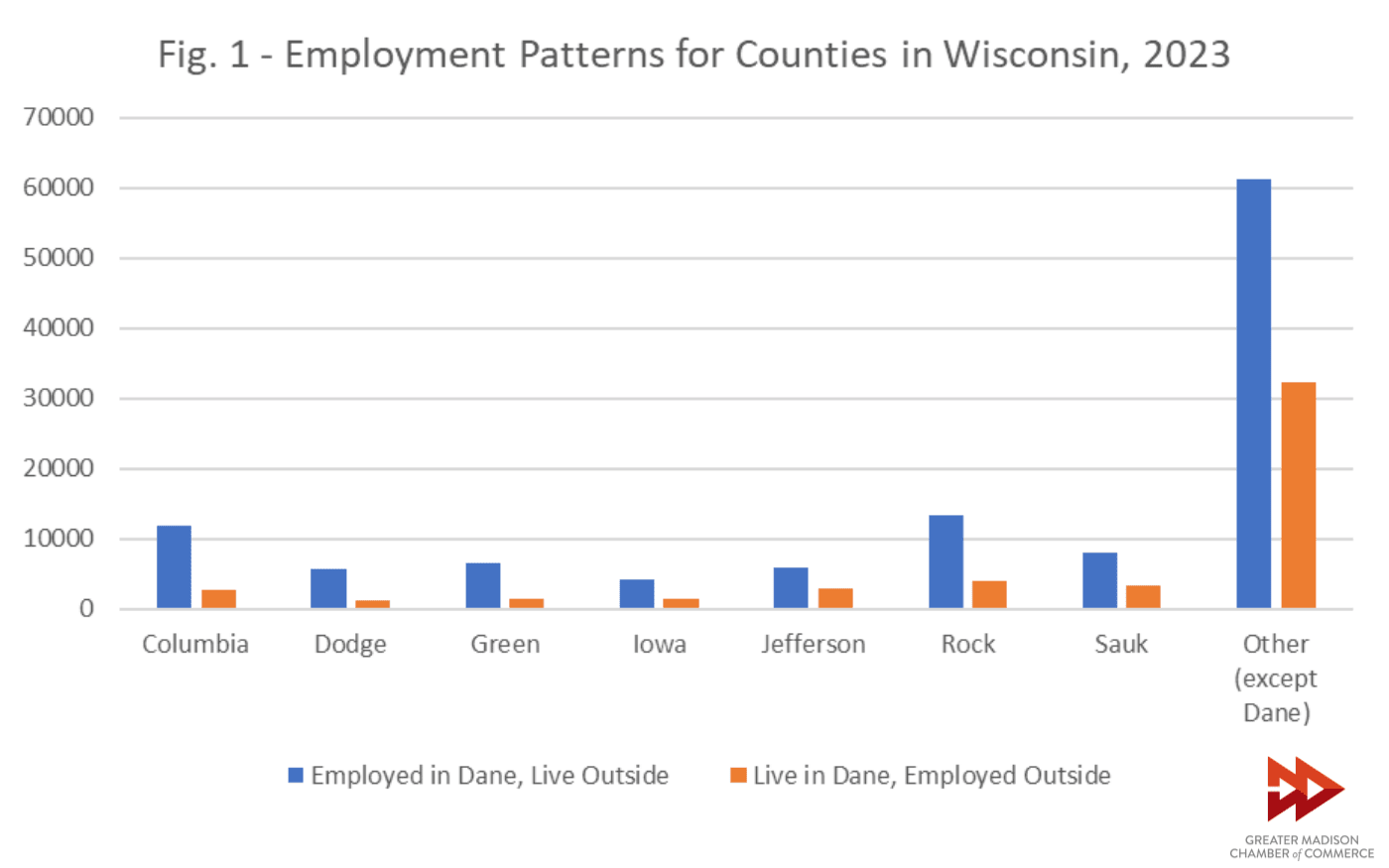
Figure 1 shows Dane County’s workforce spread across all contiguous counties, with roughly one-third of people employed in Dane County residing in another county. For every person living in Dane County and working in another county, 2.4 people live in another county and work in Dane.
Rock, Columbia and Milwaukee counties contribute the most to Dane County’s employment. For Dane County residents that work in a different county, the largest out-flow is to Milwaukee, Waukesha and Rock counties, demonstrating the important connectivity of both the I-94 and I-39 corridors.
An important caveat to this data set is it only shows where people live and work and not how they commute. As a result, it does not capture how many of these workers are working in a remote capacity.
Employment Patterns Over Time
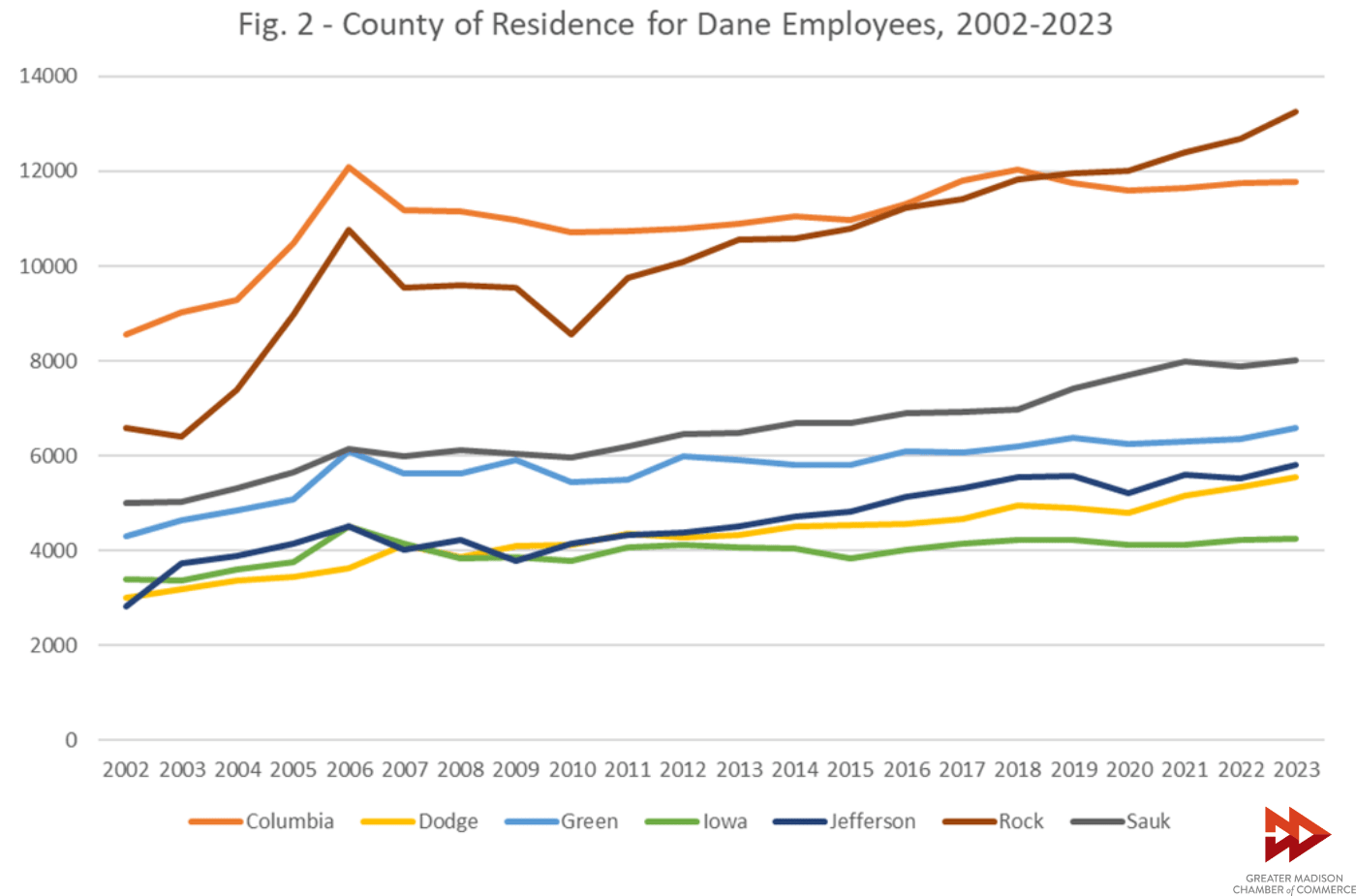
Looking further back to 2002, the increasing economic connection between Dane County and Rock County, in particular, is even more apparent.
Figure 2 looks at the county of residence for people employed in Dane County over the entire available dataset. The number of Rock County residents working in Dane County more than doubled over the time period from 6,579 to 13,256. This is the case for other counties as well, notably Jefferson County, which more than doubled its number of residents that work in Dane County over that period.
The increase in economic integration between Rock and Dane Counties is also supported by WisDOT traffic count data (Fig. 3), which shows traffic along the I-39 corridor increasing by 10% from 2020 to 2023, which matches data from LODES showing a 10% increase in Rock County residents working in Dane County over that same time period.
Conversely, when exploring the counties where most Dane County residents are finding employment opportunities, Rock, Sauk and Jefferson Counties lead the way (Fig. 4). Since 2002, the number of Dane residents choosing to work in Rock County has increased by 12.4%, the number working in Sauk County has increased by 31.2%, and the number working in Jefferson has increased by 45.4%.
Images